Sunday, November 18, 2012

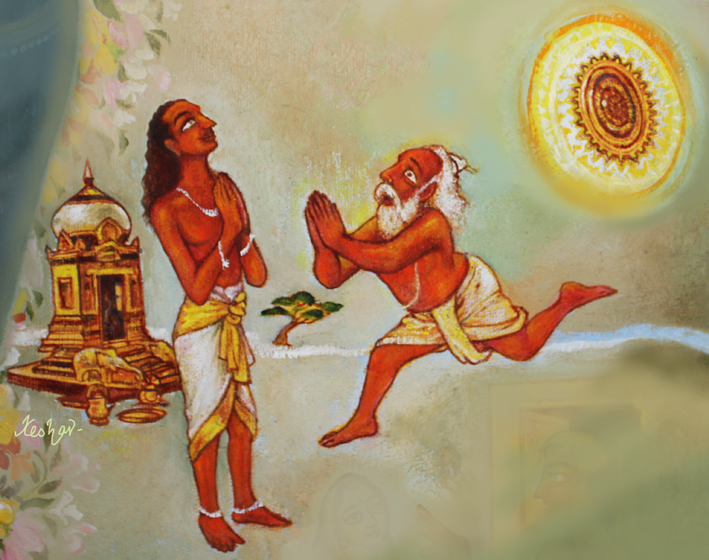
28 Bhagavatha:  Story of Ambarisha

Vivaswan's (Surya) son was Vivaswatha Manu (Shraddhadeva).  Shraddhadeva, through his wife Shraddha, begot ten sons Ikshwaku, Saryati, Nabhaga and others.  This was the famous solar dynasty. Nabhaga's grandson was Ambarisha.
Ambarisha inherited the kingdom with all its glorious wealth and unequalled power. A blessed soul, Ambarisha regarded all that as objects in a dream, by virtue of his devotion to Lord Vishnu. Pleased with his devotion and love, Srihari bestows his own discus, the Sudarshana Chakra to Ambarisha. Ambarisha places it on the throne and worships it.
Ambarisha undertakes the vow of Dwadasi (observing a fast with the mind fixed on Srihari, on the twelfth day of every fortnight of a lunar month) along with his wife, who was equally devout. On one occasion, Ambarisha, after observing the vow, prepares to conclude the fast after giving away gifts to his subjects, according their desires. It was then, that the glorious sage Durvasa, renowned for his quick temper, unexpectedly appears as a guest. Ambarisha welcomes him and invites him for lunch.  The sage accepts and goes to the river Kalindi (Yamuna) to bathe.
The vow of Dwadasi requires that the fast is to be concluded during the hours of Dwadasi itself.  And there was just about a muhurtha (about twenty four minutes) left in which he had to break the fast.  He had a moral dilemma -- on whether he should wait for the sage to return for lunch or break his fast before the hour of Dwadasi ends. He consulted his advisers and decided that sipping water is akin to breaking the fast, and yet cannot be considered as taking food. He took a sip of water and contemplating on Srihari, waited for the sage to arrive.
Sage Durvasa returned and intuitively knew what had transpired. He flew into a rage, "You have broken your fast without offering food to me -- I shall show you the consequences of such an unrighteous act." He pulled out a lock from his matted hair, created a krtya (female evil spirit) out of it, and directed it at the king.  The krtya, emitting flames, and with a sword in hand, rushed towards Ambarisha.  Ambarisha did not stir.
The Sudarshana chakra of Lord Vishnu, which protected him at all times, burnt the kritya and whirling around, emanating flames, turned to sage Durvasa. The sage runs for his life. Sudarshana follows the sage wherever he went, scorching him. Durvasa seeks asylum from the creator Brahma, who concedes his inability to protect him. Durvasa runs to Mount Kailasa, and seeks Lord Shiva's protection.  Lord Shiva also says he was powerless over the weapon of the infinite Supreme. He says only Srihari can protect him.  Left with no alternative, Durvasa rushes to Vaikuntha and falls at Srihari's feet, seeking refuge.
Srihari replies, "My heart is in possession of my devotees, O sage! I am not independent of them. Even Lakshmi is not as beloved to me as my devotees are. Pious souls are my very heart. Force employed against the righteous brings harm to the striker himself. Therefore, O Durvasa, there is only one way you can save yourself -- approach King Ambarisha and seek forgiveness from that blessed soul. Then alone will you be at peace."
Durvasa, unable to withstand the heat of Sudarshana,  rushes back to King Ambarisha and clasps his feet. Ambarisha, ashamed about the sage Durvasa touching his feet, addresses Sudarshana, the missile of Srihari. He glorifies the Chakra with prayers. He pleads that the sage be granted safety and be rid of his trouble. Sudarshana cools down on hearing the King's entreaty. Thus rid of the burning heat, Durvasa pronounces his highest blessings on the king and departs to Brahmaloka.
It is said that a whole year elapsed since Durvasa fled, seeking refuge in various lokas.  Ambarisha waits for Durvasa's return, subsisting only on water during that time.
Ambarisha discharged his duties of a ruler with devotion to Srihari.  In due course, he gives charge of the  kingdom to his sons and retires to the forest.  He spends the rest of his time meditating on the Lord.

Saturday, November 17, 2012

27 Bhagavatha -- Matsya Avatara

King Parikshit, asks sage Shukha: "O divine sage, I now wish to hear from you the story of the very first avatar of the Lord as the mighty fish. Why is it that he preferred  the fish which is tamasika (quality of dullness, ignorance, inertia) by nature?"
Sage Shukha continues his narration of the Bhagavatha, the stories of the Lord.
The almighty assumes various forms to uphold dharma.  At the end of Brahma's day (which lasts a seemingly countless number of years), when he retires for the night, there comes a time when the entire earth is washed away for regeneration, devoid of any activity and the absence of the three gunas.
Brahma, tired after his long day, unconsciously murmurs the vedas. The demon Hayagriva (with a horse's head) steals the vedas (knowledge) by dint of his yogic power. The Lord Srihari assumes the form of Hayagriva and vanquishes the demon Hayagriva. Then he assumes the form of a fish and retrieves the vedas from the dreadful deluge.  He continued to be in the waters until the next creation.
In the kalpa (a measure of time) which just concluded, there was a royal sage Satyavrata. He was devoted to Lord Narayana.  One day, when he was performing austerities in the river Kritamala (a river in the south of India), a fish got into his palms while he was offering water to his ancestors. As he prepared to drop it back into the water, the fish spoke: "I have sought refuge in you, O King. Please don't throw me away at the mercy of those aquatic creatures who kill their own species." The merciful king put the fish into the kamandalu and carried it to his hermitage. 
The fish grew bigger and again appealed to the king for bigger space. The king shifted the fish to a pitcher. In less than an hour's time, the fish grew to three cubits in length, necessitating a further change in accommodation. The fish was shifted to a pond, and then a lake. The fish kept growing to monstrous levels occupying fully the space it was provided. The time came when it had to be shifted to the ocean. The fish said, "Do not leave me here, O valiant King! The mighty alligators and other aquatic animals pose a severe threat to my life."
Satyavrata asks the fish, who had by now become a huge whale with a golden hue: "Your exploits as the great fish makes me conclude that you are Lord Narayana himself. Hail to you, O supreme Person! Your descents on earth is always for our benefit. I wish to know the purpose for your avatara as the Matsya."
The Lord replied: "On the seventh day from now, the terrestrial regions will be submerged in the waters of the deluge. I will be sending you a spacious boat which will approach you. Collect all the herbs, the annual plants, seeds of all types, the seven seers, animals of all types and board that vessel.  Sail undaunted in that expanse of water, which will be devoid of light. You will be guided solely by the effulgence of the sages aboard.  Attach the vessel (which will be tossed about by the gales), by means of the serpent Vasuki, to my horn. I shall be present in the water pulling you all, as long as the night of Brahma lasts. In the course of the journey you will realise the transcendent reality -- the para Brahma." And the Lord disappears.
Satyavrata awaits the time for the journey contemplating on the divine Matsya.  Clouds gathered and the rains poured. The ocean began to rise steadily inundating the earth on all sides. Satyavrata did as he was commanded and boarded the boat along with the sages, herbs, animals etc., The sages prompt him to meditate on the Lord to help overcome the calamity.  Concentrating his mind deeply on the Lord, Satyavrata finds the Lord again, as the dazzling golden whale.  He fastens the boat to the horn of the divine whale (with Vasuki as the rope).  He prays to the Lord to help him cut the knots of ignorance and seek the ultimate truth.
The Lord teaches the highest truth to Satyavrata, and reveals the mystery of his own self, elaborated in the Matsya Purana.
When Brahma arises from his slumber at the end of the deluge, Lord Hari restores the vedas to him.
Satyavrata, in the present Kalpa, is Vaivaswatha Manu (the son of Surya, the sun) or Shraddhadeva.
-------------------------------------------------------------------------
What the allegorical story means:
    1. The fish represents the different propensities of the mind, turbulent until it becomes spiritual, guided by the guru.  Otherwise it keeps on outgrowing whatever other space it is provided with.
    2. Bhagawan Matsya is the sadguru.
    3. Satyavrata is the seeker(the soul, jeeva) in quest of Truth.
    4. The boat is the body and Vasuki is the mind itself.
    5. The ocean is the tumultuous passage of life.
    6. The saptarishis (seven sages) are the symbol of ethics and spiritnual endeavour.
    7. The sleep of Brahma means that a person overcome by inertia loses spiritual knowledge. Vishnu restores that knowledge.

Friday, November 16, 2012

26 Bhagavatha - Vamana Avatar.

King Bali, the king of the demons was defeated and killed in the battle by Indra. Bali was brought back to life by the guru of the asuras, Shukracharya (and other descendants of the sage Bhrigu).  They help him perform a sacrifice called Viswajit, intended to conquer the heavens. A majestic chariot emerged from the fire, fully equipped with armour and weaponry. Bali with his powerful generals and army, marched towards Amaravati, the prosperous capital city of Indra.
Indra, was amazed at Bali's recovery and wondered what had made him so unconquerable. He seeks his guru Brihaspathi's advice. Brihaspathi answered that Bali had been infused with the spiritual energy of Shukracharya and it would be near impossible to fight him now. He suggests that Indra and the other gods go into hiding until an opportune time - when Bali disobeys his guru Shukracharya. The gods leave their splendorous abode. Bali, the grandson of Prahlada, occupied Amaravati, which was deserted by the gods.  Enjoying the most prosperous kingdom endowed with overflowing wealth, Bali felt he had accomplished all that he wanted.
Aditi, the mother of the gods, feels distressed that her sons have been hounded out of their abode by the asuras. Sage Kashyapa, her husband, visits her after a long time of abstract meditation. He asks her the cause for her grief. She answers that all their wealth and domain has been usurped by the mighty daityas. She pleads with her husband to find salutary means by which her sons, now exiled, will regain their fortune and glory. Kashyapa wonders at the maya of the Lord and speaks to her with a smile: "Worship Lord Vasudeva, dwelling in the heart of all living beings, for he is the only one who can fulfill your desires." He also teaches her to observe the payovrata, a rigorous vow intended to propitiate the Lord -- performed with milk-diet and with the mind focused the Lord for 12 days. With utmost discipline, Aditi performs the vow and the Lord Vasudeva manifests himself before her.  "I know that you seek the triumphal glory of your sons. The asuras are now invincible, O celestial lady. Therefore, I shall be born to you as your son and redeem the glory of the devas." And he disappears.
In due course, the Lord is born.  Aditi and Kashyapa looked on in wonder, as Vasudeva assumes a very short stature, as that of a dwarf, Vamana.  Eminent sages, lead by Kashyapa, invest him with the sacred thread.  The gods honour him. Bhoomi gives him the deerskin, Chandra (moon god) gives him the sacred staff. Aditi gives him the loin cloth. Dhyauh (god presiding over the sky) gives him an umbrella. Brahma gives him a kamandalu, a wooden vessel to hold water.  Saraswati gives him the aksha mala (a rosary). Kubera (god of wealth) gives him a vessel to receive alms. Uma, (mother of the universe), gives alms. The seven seers (sapta rishis) give him Kusha grass. Thus the brahmin boy, Vamana, began his worship of the fire every day.
Hearing that King Bali was propitiating the Lord, by means of an Aswamedha yagna (a sacrifice), Vamana proceeds to the Bhrigu-Kaccha, on the northern bank of river Narmada.  The priests there and King Bali himself were amazed by Vamana's splendour -- as though he were the divine sage Sanatkumara himself.  Overpowered by his lustre, the Bhrigus (Shukracharya) and King Bali welcome him. Bali washes the feet of Vamana as a mark of respect.  Bali submits "Our land has been consecrated by your tiny feet.  Pray, O brahman, take from me whatever you desire."
Vamana glorifies the ancestors of Bali, Virochana and Prahlada. "O ruler of the asuras, I seek from you a strip of land, three paces long, as measured by my stride. I seek nothing else from your magnanimous self."
Bali replies, "Your words, although commendable, is quite childish. How unwise of you to ask just three paces of land, when I could give you a whole continent. Please accept land enough to afford you a decent living."
Vamana replies: "The dearest objects of the three worlds cannot satiate one who has not been able to subdue his senses and mind. Contentment with whatever is obtained by chance is conducive to liberation. Therefore I ask you only three paces of land from you."
Bali laughingly says, " Take as much as you will." He takes a pot of water to make a solemn vow to grant him the land. His guru Shukracharya, interjects -- "This dwarf is none other than Lord Vishnu, who has come to accomplish the purpose of the gods. I do not approve of what you have promised to him. He will snatch your throne, dominion, fortune and glory and bestow it to his brother Indra."
Bali respectfully submits: " Having promised the brahman, how can I go back on my word?  When sage Dadhichi and King Shibi give away their own lives to living beings, what scruple can be there in giving away mere land? Therefore I shall give the promised land to this brahmachari, even if he is an enemy or Lord Vishnu himself."
Disobeyed by his disciple, Shukracharya cursed the high-minded Bali, "You have grown so arrogant so as to violate my command. You shall soon fall from your high position for having disregarded us."
Bali unmoved by the imprecation, worships Vamana by washing his feet, pours water from his right palm on to Vamana's hand, to solemnise the gift.
Now Vamana proceeds to measure the three paces of land.  The diminutive Vamana, grows and presents himself in his cosmic form. The asuras were seized with fear. With a single stride he measures the earth. With the second stride, he covers the whole of the heavens and the sky, that there was not an atom of space left for the third.
The Lord's foot pierced through all the spheres and reaches Satyaloka, the abode of Brahma. Brahma along with sages Narada, Sanandana, Marichi and the others, bow to the foot of the Lord. The water from the kamandalu of Brahma, which washed the foot of the Lord came to be known as the holy Ganga. Jambavan, the king of the bears, circumambulates the Lord with the speed of thought. 
Vamana, contracts his proportions and becomes diminutive again. Enraged that their master has been deceived by Vamana, the retinue of asura generals rush with weapons to strike at the divine dwarf. Vishnu's attendants laughingly ward them away. Bali stops the asuras. " Retreat, my fellow asuras. The same Lord who had been conducive to our growth and the decline of the gods, is proving the reverse now. None can override the time-spirit through physical strength. Therefore await the time when it turns to our advantage." The asuras withdraw to the netherworld. Garuda binds Bali with the cords of Varuna.
Vamana claims the third pace of the promised land which is now non existent. Bali submits with a calm mind: "Pray, place your third step on my head. I regard as most laudable the punishment inflicted by the most worthy. You are indeed the greatest benefactor to us asuras."
Vindhyavali, Bali's wife prays to Vamana: " O Lord! When there is nothing which one can rightfully call their own, what can they offer as a gift to you, who creates, protects and also destroys the Universe?"
Brahma asks Vamana to excuse Bali, who has already been stripped of everything, and hence no longer deserves punishment.
Vamana replies, " O Brahma, I take away the fortune of whomsoever I show my grace to. A person with wealth and power becomes stiff with pride, and disregards the world and myself. This asura Bali has conquered my invincible maya (power of delusion). Despite the distress, he does not feel perplexed. Subjected to curse and bodily torture (being bound by the cord of Varuna), and deserted by his generals,  this asura had a firm resolve and did not abandon truth. He has already achieved my realm, but since he wished to become Indra, he will rule under my protection during the time of Savarni manvantara. Until such time, he will occupy the subterranean region of Sutala, whose beauty has been enhanced by the architect of the gods, Viswakarma. Agonies of various kinds will never overtake the denizens of that region. Bali, may good betide you." 
Bali, overwhelmed, bows and prays to Vamana and prepares to enter the Sutala. Vamana asks Shukracharya and other priests to accomplish whatever has been left incomplete by Bali.
Vamana restores the sovereignty of the heavens, thus begged by him, to his elder brother Indra, and returns to his own realm.

Thursday, November 15, 2012

25 Bhagavatha:  Amritha and the Mohini avatara (The churning, part II)

The devas continue their churning with renewed enthusiasm. Out of the churning, emerge Surabhi/ Kamadhenu, the cow of plenty, Ucchaishravas, the gleaming white horse, Airavata, a white elephant with four tusks, Kaustubha, a type of ruby, Parijata, a celestial tree, the Apsaras, the celestial nymphs with their unique charm and many other precious objects.
Then appears Ramaa, (Lakshmi) illuminating the entire area with her splendour. Struck by  her supreme nobility and beauty, demons, men and the gods long for her except Vishnu. 
Indra gives her a wonderful throne. The rivers in a personal form bring the sacred waters for ablutions. Gandharvas sing auspicious songs. The elephants guarding the four quarters bathe Lakshmi. The ocean presents her with yellow silk. Varuna presents her with a garland. Vishwakarma provides her with ornaments. Saraswati provides her with a pearl necklace. Brahma gives her a lotus, and the Nagas present her with ear rings. Holding a wreath of lotus flowers in her hand, she moves about gracefully, in search of a match for her  - a person without blemish, one who is eternal, possessing everlasting virtues. She deliberates for long and finds Lord Vishnu to be perfect. She garlands him with a bashful smile and stands beside him. Vishnu makes his bosom her permanent abode. Ensconced there, Lakshmi promotes the welfare of everyone with her benign looks.
Then comes the moment everyone was waiting for.
Lord Vishnu appears in a dazzling form as Dhanvantari, holding a golden vessel which contained amritha (nectar). The asuras, eager to have the amrita, snatch the vessel and carry it away. A quarrel arose in their ranks as to who would get the nectar first. Amidst the confusion, Vishnu assumes the form of Mohini, an indescribably attractive  damsel.  They were overawed by her presence. She moves about among the demons, enticing them with her glances. With blinding passions in their hearts, they adore her with sweet words:  "We, the sons of Kashyapa have exerted ourselves for this prize. O charming Lady, will you agree to distribute this nectar equitably amongst us?"  Mohini laughs, " You repose trust in me, a wanton woman?" The asuras feel reassured by her self deprecating humour.  Mohini says she would oblige, provided they accept whatever she did, without any question. The asuras completely under her spell, agree, without much of a thought and hand over the amrita to her.
They all fast for a day, purify themselves with auspicious rites and prepare themselves for the much awaited event. Mohini, charm personified, walks in with the amrita kalasha. She seats the devas and the daityas in separate rows and begins to give the nectar first to the gods.  The asuras are impatient but respect their promise. Swarbhanu (Rahu), a demon disguised as a god, sits between the Sun and the Moon.  When it is Rahu's turn for amrita, the Sun and moon point him out. Mohini slices his head off with the discus, Sudarshana. But due the effect of the nectar, he lived on in two parts as shadow planets, Rahu and ketu. The asuras realise they have been deceived. Mohini vanishes.
Hostilities break out between the demons and the gods. Reinvigorated by the amrita, the devas rage a dreadful battle against the asuras. The gods manage to defeat many a demon in the battlefield.  Perceiving a complete annihilation of the demons, Brahma sends Narada as an emissary. Narada reasons with the gods: "Now that you have secured amritha with the grace of Srihari, and also been blessed by goddess Lakshmi, you should cease hostilities."
Bowing to Narada's wish, the gods give up their anger and stop the war.  King Bali, killed in the battle, is taken to their preceptor, Sukracharya, who revives the king to life with his unique secret knowledge.
-----------------------------------
What the allegorical story conveys:
Indra represents a person in high position. His negative thoughts (demons occupying his kingdom) spurn the spiritual thoughts (Durvasa) and he becomes weak.
The ocean of milk is the mind; the personality of the spiritual seeker. The turbulence arising in his mind during meditation is the churning.
Mandara mountain is the sense of 'I' within oneself (ahankara).  It sinks as it is not steady and focused. The Lord helps it up. Vasuki the serpent is our will power. Kurma, the tortoise signifies the withdrawing of the senses inward for spiritual realisation.  Kalakuta poison represents the foul thoughts and desires troubling the seeker's mind. It is absorbed and eradicated by the eternal Guru, Shiva.
The treasures from the ocean (siddhis) are powers which accrue to the seeker that delay spiritual progress. 
Chandra (moon) is fine mental creativity, distracted by undesirable thoughts (Rahu, the asura).
Lakshmi is prosperity personified, who is capricious and transitory until she becomes Vishnu's consort.
Dhanvantari is the purified mind, which possesses the amrita (the state of complete fulfillment or bliss).
The gods and demons (devas and daityas)  are the virtues and vices within us. Vishnu suggests that we harness the skills attributed to our negative thoughts for introspection.
Mohini is an illusory attraction.  It shows how one should outwit the demons which disturb our thoughts.
The asuras, one's lower mind, cannot discriminate using the buddhi (intellect). Agitation weakens their minds.

Wednesday, November 14, 2012

24 Bhagavatha: The churning of the Ksheerasagar (part I)

The sage Durvasa was returning from Vaikuntha with a garland bestowed on him by SriHari. He meets Indra who was on his Airavatha. He gives the flower garland to Indra.  With disdain, Indra threw it on the head of Airavatha, which in turn, hurls it to the ground and tramples it.  Angered, Durvasa curses Indra, that he and the world he ruled, would be divested of  power and splendour.
The gods lose their glory and seek Brahma's counsel.  Brahma meditates on the Supreme. Hari says:  "It is Amritha (nectar) which will help you regain your lost glory and make you immortal. But first you have to make peace with your cousins, the daityas (demons). You will obtain nectar only by churning the ocean of milk. Throw the medicinal herbs, grass and creepers into the ksheerasagar (ocean of milk). Place the mandara mountain as the churning rod,  and churn it with the snake Vasuki as the rope.  You should not be afraid of the severe poison which will emanate out of it, nor you should desire or be jealous with respect to objects arising out of the churning; it is those objects who will chose its owners. I will be there to help you in this endeavour."
The gods conciliated the demons by speaking to their great king Bali about the churning of the ocean of milk.
Cultivating a friendship, they put forward their robust energies for the sake of amritha.
Together, they uproot the Mandara mountain and carry it to the ocean. Unable to withstand the weight, the exhausted gods and demons dropped it on the way, crushing and injuring many. They are disheartened. Hari appears on Garuda. He heals and revives all those who came under the impact of the mountain's weight.  He helps place the mountain on the seaside, with the help of Garuda. After the effort, Garuda withdraws, to make way for Vasuki (who was afraid of Garuda), to assume his role as the rope.  Vasuki (assured of a share in the rewards) is twined around the mountain for the churning.
Srihari holds Vasuki at the fore part (the head) for the churning. The daityas consider it an insult to hold the other part, the tail of the snake, and refuse. Srihari smilingly concedes and the gods hold the tail of Vasuki. Thus defining their positions, the sons of sage Kashyapa, the devas and the daityas begin the churning with vigour.
But the mountain, having no support under the ocean, sank due to its massive weight.  Lord Srihari, assuming the form of a giant tortoise, plunges into the ocean and bears up the mountain on his back. Enthused, the team begins to churn again. The thousand heads of Vasuki spewed fire and scorched the demons. Srihari manifests himself in both the devas and the daityas, stimulating their energies required for the churning. Also, he strengthens Vasuki with suspension of consciousness, to numb the pain rising out of his mammoth task. With one hand, Srihari also held the mountain at the top to prevent it from springing up. They continue churning for a long time, but there was no sign of any nectar. To speed up things, Srihari holds both ends of Vasuki with his arms and hastens the churning. This churning agitated all the creatures living in the ocean.
What first arose was the Kaalakuta,  a deadly poison, which spread very fast, threating all life forms. They all appeal with prayers to Lord Siva. Siva tells his consort,  "Observe, Bhavani,  how the living beings are on the verge of a calamity in the form of the Kaalakuta poison. The virtuous protect others by sacrificing their own transient life. I hereby swallow this poison,  to please Hari and ensure a prosperous life to all created beings." With Bhavani's consent, Siva squeezed into his palm the Kaalakuta and swallowed it out of compassion, the power of which even made an impact on the Supreme person's throat, which turned blue. This spot became an ornament to that benevolent soul.  He was hailed and glorified by the living beings as Neelkantha.(contd.-- part II)

Tuesday, November 13, 2012

23 Bhagavatha : Gajendra Moksha

Indradyumna, was a Pandya king devoted to Lord Vishnu. The monarch turned an ascetic and had his hermitage in the Kulachala mountain. He continued his worship with a vow of silence with a subjugated mind. Sage Agasthya, happened to arrive there with his disciples. Finding Indradyumna not offering him water or any sort of welcome, the sage felt disrespected.  He cursed Indradyumna. "Let him be born as an elephant, steeped in blinding ignorance." 
He was born as an elephant, Gajendra, and roamed about in the valley of the great mountain Trikuta. Leading a big herd of elephants and his young, he enjoyed life to the brim.
Once when he was sporting with his herd in a lake, a powerful alligator seized him by the foot. However much he tried, Gajendra could not extricate himself from the mighty jaws of the alligator. The female elephants, shrieked out of helplessness and the other elephants, trying their utmost to help him, gave up. Gajendra tried to pull himself outside and the alligator tried to pull him in. This tug of war continued for a long time.
Gajendra's strength depleted, but the alligator's strength kept increasing. The  herd of elephants leave one by one, unable to help him, until he was left all alone. He thought, how can my kith and kin help me, when they have no power to extricate me from this entrapment of Providence... Only the ultimate refuge of all, Lord Vishnu will be able to help me. His remembrance of the Lord at the most appropriate time was due to his adoration of Lord Vishnu in his earlier birth as Indradyumna. He calls out the same prayer mentally, glorifying the compassionate qualities of the Lord. Lifting his trunk, he offers a lotus to him. In an instant, the Lord Srihari, manifests himself on Garuda, wielding his discus, Sudarshana.  Gajendra, gathers enough strength and hails Lord Narayana, as the Adiguru (the preceptor of the universe). The Lord gets down from Garuda in a trice, and holding Gajendra's trunk, pulls him out of the lake, along with the alligator.  He extricates Gajendra from the hold of the alligator, whose jaws were rent open with the discus.  Gajendra is transformed into a divine attendant of the Lord. The alligator was also redeemed --- he regains his form as Huhu, a gandharva (celestial musician). He also pays obeisance to the Lord.
(Huhu, out of haughtiness, had played a prank, pulling the leg of the sage Devala from under the lake when he was bathing. The Sage cursed him to become an alligator).
And Lord Vishnu withdrew to his transcendent realm called Vaikuntha.

Monday, November 12, 2012

22 Bhagavatha - Narasimha and Prahlada

The Dwarapalakas of Vishnu were born as asuras Hiranyakashipu and Hiranyaksha, due to the curse of the sages Sanatkumaras. Hiranyaksha, who was younger, was killed by Vishnu as Varaha. Hiranyakashipu who felt miserable, consoles his brother's wife Rushabhanu, and also his sons. He comforts his mother Diti, with words steeped in Dharma. "Do not grieve for Hiranyakasha whose death was brave and praiseworthy. The soul is eternal and transcendant, taintless and free from decay. Living beings dwell together and are parted by Providence on account of their past actions."
But Hirankashipu himself was agonised and vows to avenge his brother. He implores the danavas in his court: "You all shall go to earth and destroy everything that sustains the memory of Lord Hari."
Hiranyakashipu, in the quest for invincibility, practices austerities of the severest type until Brahma appeared. Blessing Hiranyakashipu, whose body was eaten away by ants, Brahma sprinkles water on him.    He emerges as fire from fuel, endowed with great power, youth and an appearance like gold. He hails Brahma as the Supreme and seeks boons. "Let not my death be through any being created by you. Let there be no death indoors or outdoors, by day or by night, nor by weapons, neither in earth nor in air, neither from men nor animals, neither from animate or inanimate things, nor from gods, asuras or the nagas. Let me have undisputed Lordship." 
Meanwhile, Prahlada was born to his wife kayadhu. He was born with Lord Hari firmly established in his mind.
Hiranyakashipu, armed with the boons secured from Brahma, subjugates the three worlds and establishes himself as the sovereign ruler. 
When Prahlada was five years old, Hiranyakashipu sends Prahlada to the sons of Shukracharya, Shanda  and Amarka for their education. Prahlada who was a devotee by nature, grasped all that he was taught but  never approved of it.
Once, the teachers brings Prahlada to the court of Hiranyakashipu. The king lovingly takes Prahlada on his lap and asks him what he regarded as good for him.  Prahlada replies that all embodied souls should seek refuge in the Lord.
Hiranyakashipu gets angry and rebukes the gurus. The gurus refuse to have taught any such thing. Prahlada is sent away again for proper training.
His gurus intimidate him with caning and teach him what was mandated by the king. But Prahlada saw Hari in those gurus too and in his surroundings.  He was averse to the distinction between a friend and a foe. In the course of his stay in the hermitage of the gurus, Prahlada preaches the glory of the Lord to the other asura children too.
Repeatedly, Prahlada was asked by his father after regular intervals about his learning, and every time, Prahlada tells only about the glory of Hari, who was present everywhere. At this point, Hiranyakashipu could not take it any longer and begins his attempts to kill Prahlada by various methods.  Every time he is miraculously saved, Hari being entrenched in his heart. 
Hiranyakashipu screams, "you are my son and you are preaching to me about Hari? Where is your protector?"
Prahlada replies, " He is everywhere. In every atom."
Hiranyakashipu says, " If he is everywhere, why don't I see him in this pillar?"
Prahlada replies with conviction, " Of course, he is present."
Hiranyakashipu, drawing his sword,  sprang up from his throne and knocked at the pillar with his fist. He heard an explosion as though the cosmic shell had cracked. Out of the pillar, roaring like thunder, emerges an incandescent figure, a queer beast, neither an animal nor a man. It was the Lord, in the man-lion form of Narasimha.  With a shrill laughter, he seized the demon, who was darting up and down with the swiftness of a hawk, and at the doorway of the hall, slung him across his thighs. It was evening then. And with his sharp nails and teeth, tore apart the asura, whose skin could not be scratched even by Indra's vajra. He also had satisfied all the conditions which he had sought as a boon.
The devas lead by Brahma and even Lakshmi feared to go near Narasimha, as his anger did not subside. Brahma asks Prahlada to speak to Narasimha. Prahlada goes near the Lord and prostrates. Looking at Prahlada, Narasimha's anger vanished.  He took Prahlada on his lap and started to lick him, as a lion would do to its cub.
Prahlada extolls him.  Narasimha, pleased with his foremost devotee, offers to give him any boon which he would seek. Prahlada replies that he is a devotee without any craving or desire. "One who seeks worldly blessings from you, is but a businessman. If you still wish to bestow a boon, let it be that no desire may ever sprout in my heart.  And also forgive my father, who was ignorant of your divine glory and spoke ill of you."
Narasimha says, "Your father and twenty-one generations before him have been purified because you were born unto this home, my child.  Perform his obsequies and also occupy the throne of your father.  With your mind fixed on me, dear son, perform your duties as directed by the exponents of the vedas. You will be a role model for all my devotees."
Narasimha also asks Brahma to desist from giving any more of such boons to the asuras, as they are evil by nature. Then Narasimha disappeared.
Prahlada is crowned king and he rules according to dharma.

Sunday, November 11, 2012

21 Bhagavatha -- Atri and Anasuya

Atri is one of the saptarishis. He is believed to be the manasaputra of Brahma. (Atri, meaning one who is
free from the three gunas, emerged from the eyes of Brahma). His wife is Anasuya, daughter of Kardama Prajapati (Anasuya - free from jealousy). 
Atri's austerities were legend. It is said that when he controlled his breath through pranayama, smoke emanated from his head.
Anasuya was an embodiment of chastity. Once, in order to glorify her chastity to the world, Brahma, Vishnu and Siva visit Anasuya's ashram as Brahmins and seek bhiksha (for food) with the condition that she should serve it without any clothes on. Anasuya without any hesitation agrees. She invokes her devotion to her husband and sprinkles some water on her divine guests, who become small babies. The trio blessed them with three sons, Datta (a manifestation of the three forms of the Lord, Brahma, Vishnu and Siva), Sage Durvasa (one who was free from vasana), and Soma (the moon god). 

Saturday, November 10, 2012

20 Bhagavatha -- Indra and the slaying of Vrithrasura

Once Indra was seated on his throne in all opulence. The lordship of the world had made him arrogant. When Brihaspathi, the preceptor of the gods enters the court, Indra behaves indifferently. Brihaspathi feels
disrespected and walks out.  Indra realises his folly committed in a fit of pride. He rushes to Brihaspathi to
seek forgiveness, but Brihaspathi disappears using his powers of illusion (yogamaya).  Thus deserted by his
preceptor, the gods become vulnerable.
The asuras, hearing about the predicament of the gods, prepare to strike when the opponent was weak, as advised by their guru, Sage Shukracharya. The gods were attacked and injured with sharp arrows. The gods, led by Indra seek refuge in Brahma. Brahma, rebukes Indra for his unworthy behaviour against Brihaspathi and asks them to immediately seek protection from the learned sage Vishwaroopa, the son of Twashta (the architect of the gods).
Viswaroopa agrees to be their preceptor in the absence of Brihaspathi. Viswaroopa discharges his role diligently as a priest.  He teaches Indra a prayer, Narayana Kavacha, invoking the protection of Lord Vishnu. This improves the fortune of the gods.  The Narayana kavacha acts like a shield against the asuras.  The gods emerge victorious.
But Indra comes to know that Vishwaroopa, had also offered a share of the sacrificial oblations to
the asuras in secret, as he sympathised with the asuras (through affection to his mother Rachana). Angered at this breach of faith on the part of Viswaroopa, and suspecting that he would bring about the destruction of the gods, Indra cuts off Viswaroopa's head.  
Twashta, Vishwaroopa's father, retaliates by offering oblations in the sacred fire, to procure a mortal enemy
to slay Indra. (The priests, who wanted the gods to win, stealthily changed the intonation
of the mantra, which reversed the intent). Vrithrasura, fearful in form, rises out of the fire, threatening the
gods. Each of the host of missiles hurled by the gods were swallowed by Vrithra. Dejected, the gods mentally extoll Lord Narayana and appeal to him for protection.
The Lord replies: "Without any delay, seek the sage Dadhyan (popularly known as Dadichi) and beg of him the gift of his body. Dadhichi's constant repetition of Narayana Kavacha and his asceticism has made him
exceptionally strong. It is he, who had taught the Narayana Kavacha to Twashta, and the devas, in turn, got to know this through Twashta's son Vishwaroopa. The sage Dadichi, who knows the essence of dharma, will part with his body in favour of his foremost disciples, the twins Ashvinikumaras (the physician of the gods). Out of the limbs of his body, a thunderbolt (Vajra), the best of weapons will be forged by Viswakarma, the artisan. With this ultimate weapon, also strengthened with my power, you will slay Vrithra and regain your glory. Enemies can never destroy those who are devoted to me."
The devas approach sage Dadichi with this terrible request to cast off his body. The sage, replies as though in
jest: "O Gods, have you no idea of the pain caused to living beings at the time of death? The body is the
dearest to any being, hence always eager to survive. Who would have the courage to part with it at a mere
asking?" The gods reply that for magnanimous souls like him, compassionate to all living beings, nothing would be difficult to part with, if it were intended for the benefit of one's fellow-beings. Dadhichi says, "I asked you about the pain of parting with life, as I wanted to hear from you about Dharma. I will cast off my body, which is coveted by you, and which is sure to leave me one day."
Sage Dadhichi controlled his senses, and fixing his mind on the Supreme reality, identifies himself with the
Lord. He did not know when the body fell.
The Vajra was prepared from the bones of sage Dadhichi. Armed with the Vajra, Indra resumes the
battle with the asuras. The asuras flee at the onslaught, deserting their leader Vrithra. Vrithra's appeals to
his men to fight were in vain. He fights valiantly, stiking terror and crushing the gods under his feet.
Vrithra holds the mace hurled by Indra, and hurls it back, breaking the mouth of Airawatha (Indra's
elephant)and sent reeling away. Vrithra does not aim again at his fallen opponent. Healing the injured
Airavatha with his mere touch, Indra rejoins the battle.  The noble soul Vritra, recollecting the sinful deed
of Indra of killing his brother Vishwaroopa, laughingly vows to avenge the death of his brother or be slain
like a true warrior. Knowing that Vajra has the blessings of Srihari and the ascetic power of sage Dadichi,
Vrtra prompts Indra to strike.  He mentally prays that he may be born as a servant of devotees who have taken refuge in the Lord. Preferring a warrior's death, he rushes with his trident to strike at Indra. The trident
and the arm that held it, was struck down with the Vajra, a weapon with hundred joints and as thick as the snake Vasuki. Vrtra hurls a club and strikes down the Vajra from Indra's hand. A fierce one-to-one battle ensued, where the charitable disposition, guileless words and the fair-play of Vrithra, were appreciated by Indra and others who were present.
Indra appreciates him : " O Asura chief, you're blessed with such a devout mind that you have reached the end of the insurmountable Maya of Lord Vishnu." Thus speaking to each other where the nature of Dharma was revealed by both of them, the battle raged on. Both the hands of Vrtra were cut off by Indra. But the gigantic Vrtra, swallows Indra along with Airavatha.  Indra, protected by the Narayana Kavacha, cuts the belly of the Asura from within and emerges. Whirling with great speed, he also lops of Vritra's head. The soul of Vrtra merges with the Lord. 
All were happy at this triumph except Indra, who was burdened by the sin of slaying of a Brahmin. He suffered untold agony and hides himself under the Manasa lake pondering the means of absolution from the great sin. The king Nahusha officiates as the king of gods, until the time Indra redeemed himself.  Marichi and other sages perform the great Ashwamedha sacrifice, which ultimately washes away Indra's blot and re-establishes his glory.

(a note about the painting:1. Due to space constraints of the canvas,  the Airavatha, shown beside Indra, also forms part of the mount of Shiva, Nandi  2. The tree behind Dadichi hints at the spine and limbs of the sage).

Friday, November 09, 2012

19 Bhagavatha - Ajamila - significance of the Lord’s name

In the city of Kanya-kubja (today's Kanauj) there lived a brahmin by name Ajamila . Well trained in the vedic rituals, he lead a pious life, worshipping Lord Vishnu. Once, when he was collecting material in the forest for the sacrificial fire, he happens to see a drunk couple indulging themselves in mirth. Ajamila loses all sense of reason accrued by his learning and wavers from his duty.
He forsakes his aged parents and abandons his young wife too. He begins living with an unchaste wench. He spends all his money on her. After his father's fortune was thus exhausted, he gets money by foul means. He takes to gambling and liquor and also kills animals to feed his family of ten sons. He names his youngest son, his pet one, as Narayana. Engrossed in this kind of life, he does not perceive that death was approaching him. He was eighty eight years of age.
At the time of death, Ajamila beholds three terrifying figures with noose in hand about to drag him away. He calls out to his son “Narayana” --  in a loud and long tone, wanting to see his child who was at a distance, busy with his playthings.
Hearing the utterance of their Lord's name, the attendants of Lord Vishnu rushed to the spot. They forcibly stop the messengers of Yama, who were tearing away Ajamila’s soul with a noose to take him away.
Yama dhootas ask why they are being forbidden from doing their duty.  
In a deep voice like the rumbling of clouds, Vishnu’s men laughed. “If you are truly Yama’s men, tell us the true character of virtue. Do you punish all those who commit sins?”
Yama's men recount Ajamila's wayward life and detail the consequences of the sins committed by him.  As he has not atoned for it, he will be dragged to Yama’s court, where he will be purified through punishment.
In an ensuing debate, the Vishnudhootas expound the cult of devotion to the Lord and reason with
them -- “Whatever sins he may have committed, they have been wiped out by the fact that he pronounced the name of 'Narayana' at the time of death, even if he uttered it to denote someone else. Just
as medicine acts even if we do not believe in its efficacy.” They succeed in securing the release of Ajamila  from the grip of death.  He is given a chance to redeem himself.
The Yama dhootas go back and report the events to their Lord, Yama.
Ajamila, rid of his fear, regained consciousness of his earlier pious self,  by a moment's association with the
Vishnu dhootas. He bows to them.  As he begins to speak, they disappear.
Ajamila repents for his dissipation and the cruelty meted out to his wife and parents. He renounces everything and reaches Gangadvara (Haridvara) to meditate on Lord Vishnu.  Withrawing his senses through yoga -- and his mind irrevocably fixed on Srihari, he beholds the Vishnudhootas again. He bows to them. Departing from his body and assuming a divine form, he enters the aerial car along with the Vishnudhootas, ascending to a realm of the divine, known as Vaikuntha. 
 

Thursday, November 08, 2012

18 Bhagavatha - Jadabharatha and King Rahugana

Bharata, born in a brahmin family, was afraid that he could be deluded again by attachment, as
demonstrated by his earlier birth as a deer. He showed himself as being dull witted, dumb and insane. Clasping the Lord's feet in his mind, he behaved indifferently and did not heed anything taught by his father which conformed to the rules of good conduct. He deliberately mispronounced mantras. The samskaras performed on the young Bharata were but in vain.  After his parents death, his brothers despised him. Ignorant of his greatness, they treat him badly taking him to be a dunce. Stale food was given to him, but Bharata, ate it as though it were ambrosia. His unresponsive attitude earns him the name of Jadabharatha.
The king of Sauveera, Rahugana, was traveling along the banks of the river ikshumati. His palanquin bearers
needed extra help. They find Jadabharata sitting idle under a tree and order him to join them. He silently obeys and becomes a palanquin bearer. Jadabharatha walks slowly, looking at the ground below him. His slow gait and steps do not match with the other palanquin bearers. The king, feeling the discomfort due to the irregularity, reprimands the bearers. The other palanquin bearers blame it on the new bearer. The king looks at Jadabharata's robust frame and sarcastically said: " What a pity that you are so frail and tired. You have carried the palanquin alone without anyone sharing your burden." Unmindful of the taunts, Bharata quietly bears the palanquin as before and the journey continues.  On the way, he spots some ants crossing the path and takes a long leap over them, so as not to step over the poor creatures.  This movement causes a jolt and the king gets angry. He gets down from the palanquin and admonishes Jadabharatha, "How dare you disregard me! I will punish you..."
Now, Jadabharata, who had never spoken a word ever, smilingly spoke to the King:
"What has been hinted by you is evidently true and constitutes no reproach. My body, and this chariot are
unreal, as well are your words. The real 'I' within me is beyond your threats and insults. There is no difference between king and servant. Your punishment cannot affect me." He picked up the palanquin again.
Rahugana, hearing the brief reply of Jadabharatha, was shaken. Completely rid of his pride and sovereignty, he quickly gets down from the palanquin and touches the feet of Bharata, seeking forgiveness. "Your words are replete with knowledge, O pious sage, who might you be? I was proceeding to ask Lord Kapila, to impart me true knowledge of the Self. But you seem to be Kapila himself. Forgive my pride and instruct me in the Truth."
The compassionate Bharatha tells Rahugana about himself and his earlier births of a king and then a deer. Then he answers the queries of King Rahugana, about the Self, the state of worldly existence, and the path to liberation. With his allegorical stories, Bharata resolves the doubts of Rahugana. Rahugana sheds his wrong notions planted on his mind by ignorance.
"Thus is the greatness of those who have taken shelter with the devotees of the Vasudeva..." continues Sukha, who has been narrating these stories to King Parikshit.

Srimad Bhagavatham